


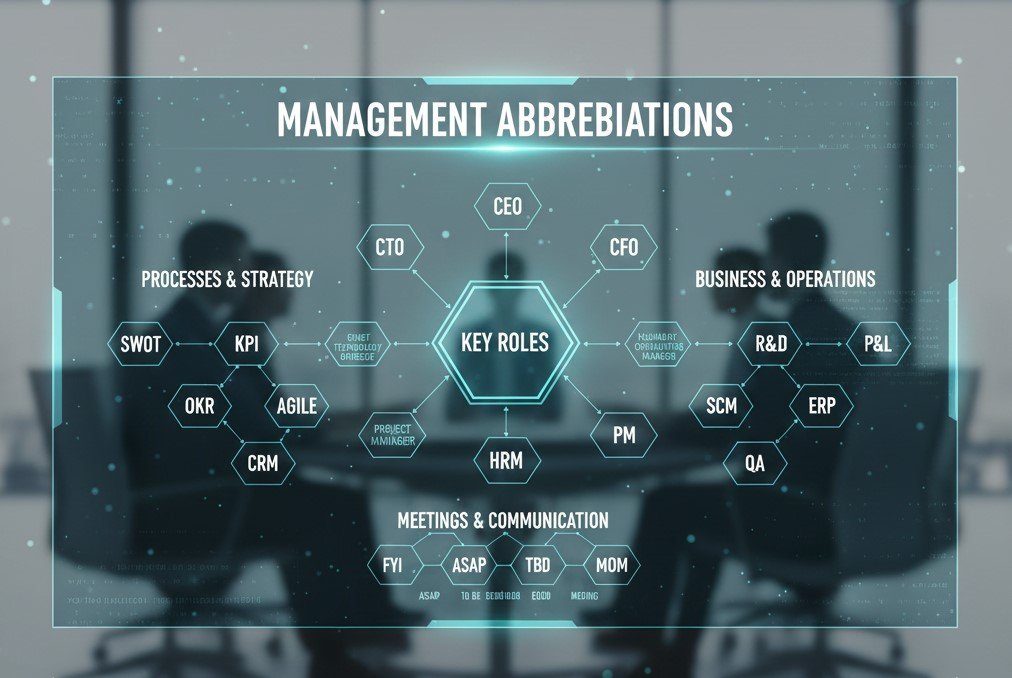
A Management Abbreviation is a shortened form of a business or leadership term used to make communication faster, clearer, and more efficient within organizations. These abbreviations play a major role in modern workplaces, especially in emails, reports, job titles, organizational charts, and internal documentation. Whether you’re entering the corporate world, leading a team, or simply trying to understand professional terminology, knowing these abbreviations helps you navigate business communication with confidence.
Background & Origins of Management Abbreviation
The use of Management Abbreviation began as businesses grew more complex and communication needed to become faster. In the past, handwritten reports and lengthy memos made corporate correspondence slow and inefficient. To simplify information flow, companies started using shortened forms of long managerial titles, department names, and operational terms.
Over time, these abbreviations became standardized and widely recognized across industries. As corporate environments adopted digital tools and global communication expanded, abbreviations became even more essential for clarity and speed.
History & “Age” of Management Abbreviations
The history of Management Abbreviation can be traced back to early industrial management structures.
Early 1900s: Large manufacturing companies used abbreviated job titles to simplify factory documentation.
Mid-20th century: As organizational charts became more structured, abbreviations like CEO, GM, and HRM became common.
Digital era: With the rise of email communication, project management software, and global teams, abbreviations expanded to include technical, managerial, and operational terms.
Today, management abbreviations are a universal part of business terminology, used in every industry—from finance to technology, healthcare, retail, and logistics.
“Physical Appearance” of Management Abbreviations
The “appearance” of Management Abbreviation refers to how these short forms look and function in written communication.
Most management abbreviations follow patterns such as:
- Initial letter abbreviations: CEO (Chief Executive Officer), GM (General Manager)
- Multi-letter combinations: HRM (Human Resource Management), KPI (Key Performance Indicator)
- Project abbreviations: PM (Project Manager), SOP (Standard Operating Procedure)
- Department codes: IT, HR, PR, R&D
They typically appear in uppercase letters to make them stand out and communicate authority or structure. These abbreviations help keep business writing clean and easy to understand.
Also Read This:- The Power of http//technolotal.org: Exploring the Future of Technology and Innovation
Types of Management Abbreviations
There are several categories of Management Abbreviation, each used for different business purposes:
1. Job Titles
- CEO – Chief Executive Officer
- COO – Chief Operating Officer
- CFO – Chief Financial Officer
- CMO – Chief Marketing Officer
- GM – General Manager
2. Departments
- HR – Human Resources
- IT – Information Technology
- PR – Public Relations
- R&D – Research and Development
3. Project & Operational Terms
- KPI – Key Performance Indicator
- SOP – Standard Operating Procedure
- ROI – Return on Investment
- PM – Project Manager
This variety shows how deeply abbreviations are integrated into every level of a business.
Core Meaning & Purpose of Management Abbreviations
The main purpose of Management Abbreviation is to create fast, clear, and standardized communication. Instead of writing long job titles or technical phrases, abbreviations save time and reduce confusion.
They help:
- Speed up written communication
- Create consistent terminology across teams
- Reduce clutter in documents and reports
- Improve organizational clarity
- Help employees understand roles and processes quickly
Abbreviations are essential in modern workplaces because they create a universal “business language.”
Relationship With Managers & Leaders
Managers and leaders rely heavily on Management Abbreviation in their daily roles. These abbreviations appear in:
- Emails
- Meeting reports
- Performance evaluations
- Organizational charts
- Leadership documents
- Project management systems
For managers, abbreviations help streamline communication, especially when handling multiple teams or large volumes of information. Using concise terms also reinforces professionalism and consistency.
Relationship With Teams & Departments
Within teams, Management Abbreviation plays an important role in collaboration. Departments frequently use abbreviations to coordinate tasks, request information, and summarize responsibilities.
For example:
- HR uses abbreviations for job roles and policies
- IT uses abbreviations for systems and technical terms
- Project teams use abbreviations for milestones and goals
- Finance teams use abbreviations for budgets and forecasts
These short forms help create smoother communication between employee groups and across departments.
Most Commonly Used Management Abbreviations
Here are some of the most widely recognized Management Abbreviation forms used in business:
- CEO – Chief Executive Officer
- COO – Chief Operating Officer
- CFO – Chief Financial Officer
- HRM – Human Resource Management
- PM – Project Manager
- GM – General Manager
- KPI – Key Performance Indicator
- ROI – Return on Investment
- SOP – Standard Operating Procedure
- R&D – Research and Development
These abbreviations appear in almost every business environment and are essential for clear communication.
How Management Abbreviations Improve Workplace Communication
The effectiveness of Management Abbreviation lies in its ability to simplify communication. Abbreviations improve workflow in several ways:
- Faster communication: Emails and reports become shorter and easier to write.
- Better understanding: Teams quickly recognize job roles and responsibilities.
- Standardized terms: Everyone uses the same terminology.
- Professional clarity: Business communication looks polished and organized.
- Reduced misunderstandings: Clear abbreviations prevent confusion over long or complex terms.
These benefits support a more efficient and productive work environment.
Also Read This:- Nuoilo 12H: A Complete Guide to Sustained 12-Hour Efficiency
Challenges or Confusion With Management Abbreviations
While useful, Management Abbreviation can create confusion when employees are unfamiliar with their meaning. Common challenges include:
- New hires not understanding abbreviation-heavy documents
- Departments using abbreviations that others don’t recognize
- Multiple meanings for similar abbreviations
- Misinterpretation of job roles or responsibilities
- Training gaps that leave employees confused
To avoid confusion, companies often provide glossaries or onboarding guides.
How to Learn and Use Management Abbreviations Correctly
To use Management Abbreviation confidently, employees can follow a few helpful steps:
- Review company glossaries or onboarding materials
- Ask for clarification when encountering new abbreviations
- Learn the most common abbreviations used in your industry
- Use abbreviations consistently to maintain professionalism
- Avoid creating new abbreviations unless necessary
- Pair abbreviations with full terms when writing for new audiences
These practices help ensure clear and consistent communication.
The Future of Management Abbreviations
The future of Management Abbreviation will continue evolving as business communication shifts toward digital platforms. With remote work growing and global teams becoming common, abbreviations will likely increase in usage. Expected future trends include:
- More abbreviations related to digital tools
- Greater use of abbreviations in virtual communication
- Standardized global business terminology
- Shortened forms for AI-related roles and departments
- Expanded use in project management platforms
As organizations adopt new technologies, abbreviations will remain an essential part of professional communication.
Conclusion
Management Abbreviation is an important element of modern business communication. It helps managers, teams, and departments exchange information quickly, clearly, and consistently. As organizations grow and adopt new tools, abbreviations continue to evolve—becoming a universal language within the workplace. Understanding these abbreviations not only improves communication but also enhances professional confidence, efficiency, and teamwork in any business environment.
FAQs About Management Abbreviation
What is a management abbreviation?
It is a shortened form of a business or leadership term used to simplify communication.
Why are management abbreviations important?
They save time, reduce confusion, and standardize communication across teams.
What are common managerial abbreviations?
CEO, COO, CFO, HRM, GM, KPI, ROI, SOP, and PM.
Who uses management abbreviations?
Managers, teams, executives, and anyone involved in organizational communication.
Do abbreviations help with productivity?
Yes, they make reports and communication faster and more organized.
Can abbreviations confuse new employees?
Sometimes, especially without training or reference materials.
Are management abbreviations used globally?
Many are universal across international business environments.
Should abbreviations always be in uppercase?
Most are, especially in formal documents, to maintain clarity.
Are management abbreviations used in email communication?
Yes, they are widely used in emails, reports, dashboards, and meetings.
Will abbreviations continue to grow in use?
Yes, especially as digital communication becomes more common.
For More Update and Stories Visit: greenpress
